back to getting started
4. working safely
4. working safely:
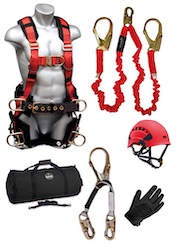
Depending on the height and the to-do list, you may be spending more time working than climbing. Working
safe is just as important as climbing safe.
Probably the most important thing a climber needs to do is also the most subtle: keeping track of their stamina.
Remember, if you get tired at 200ft, you can't just stop. One way or another, you will always have a 200ft
climb down before you're actually done. So it's important to always be honest with yourself about how much gas
you've got left in the tank. Unfinished work can get taken care of another day, and ground crew can come back on
another day. The last thing anybody wants is for the climber to get noodle-legs 100ft off the ground. If you
feel like you're about out of energy, you are out of energy, climb down!
Now that we have that out of the way, there's several general things to consider:
Do everything you can to avoid dropping things. Tether everything, including all your tools and every item
you're handling. Don't remove the tether until it's stowed or tightened down. Some things can't be tethered,
and for them you need to stop multitasking, slow down, and focus on what you're working with. Using slow,
deliberate motions, handle the items and then get them stowed or tightened down as soon as possible. For me
this generally means things like rolls of tape, screwdrivers, and hardware like nuts, bolts, and washers.
For the little hardware, I use one of those clear parts tubes with the slot in the end.
If ground crew (or anyone else) gets close to the tower while you have tools out, STOP and wait for them
to get out of the drop-zone before resuming work. Attach a pulley at the base of the tower, and run the lift
rope through that to the ground crew, so they can stand clear of the tower while lifting and lowering things.
Even when you're not using tools or handling untethered items, the ground crew should stay away from the tower
unless necessary and the climber is aware. Even a mostly empty roll of electrical tape can do damage if dropped.
Stay tethered to the tower as much as possible. When you need to reposition, first make sure you have your
gear where it needs to be, and move anything that needs to move. Clear a path. THEN disconnect, move, and
reconnect. Lastly, TEST your new connection: with hands still firmly on the tower, drop your weight on
your tether to snug things up and make sure the tether is connected properly. Only then get back to work.
Let the ground crew do all the lifting and lowering. Even if you're feeling good at the start, don't waste
your energy, you may regret it later in the day. Rest when you need to. When the ground crew is busy rigging
something for a lift or unrigging something that was just lowered, take this opportunity to relax. Take a drink,
take off your gloves for a few minutes, bend your elbows and knees.
When equipment (antennas, rotors, etc) is being raised, be ready to tether it as soon as it gets to you. Make
sure the tethers are long enough to allow you to manipulate it, and are attached firmly to strong points. Use
tag lines on equipment going up or down so the ground crew can control it and keep it away from the tower
and guy wires. Keep an eye on equipment as it's being raised and lowered. Don't rely on the ground crew to
know what's going on with the lift, you probably have a much better view of it than they do. Communicate with
them during a lift or lower, providing updates on distances, and let them know when to stop. Make sure they
understand to keep holding a lift until you give them the okay to relax the rope. Yell for them to stop if
something gets snagged. Hold lines away from the tower and keep ropes from getting tangled. Be prepared to
take the load if the ground crew suddenly loses control. On lifts, use an ascender or other "progress capture"
tool if available, so if the ground crew slips, the load won't fall.
Talk with the ground crew before climbing, make sure they know how to rig equipment. I've seem some truly
awful knots on equipment when it got to me. Like, "how did this not slip out and fall?" Make sure you have
a sack or soft toolbox or something to be able to bring up smaller items. Bring extra water that the ground
crew can use to refill your water bottle. Bring a first-aid kit, and make sure the ground crew know where
it is. Keep an emergency whistle in your climbing pack, and give one to the ground crew, in case you need
to get their attention or they get your attention. It's best if one person on the ground crew is the leader,
and others will follow directions. If you have someone attending that's not going to be doing much helping,
make them the "safety officer". Their job is to sit in their chair sipping ice tea while keeping eyes on the
tower, climber, and ground crew, looking for and pointing out risky things. Forgetting to attach a tag line
to lifted equipment, approaching a tower while the climber is working, leaving trip hazards near the tower, etc.
last updated 03/02/2026 at 09:52:46 by make_www_index.command version 2026.02.05.A