back to getting started
3 climbing the tower
3 climbing the tower:
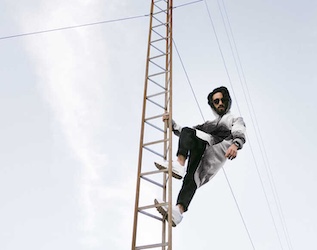
Now that you're ready to climb, it's time to think about how to get the job done while staying safe.
The first thing you need to to before stepping a foot on the tower is to read my Tower Safety Guide.
Do that before continuing...
That was just the basics of the event. Now that you're headed up, here's what you need to keep in mind. First,
the climber is usually the person coordinating the event. This is because he's the one with the most difficult,
most dangerous job. So everything that happens needs to be coordinated by the climber. He gets final say on
what gets done and how, because he's the one that will be doing a lot of it, and his safety needs to be foremost
when making decisions. So as a climber, you always have the right to say "NO". And if anyone else has a
problem with that, remind them that they can come up and do it themselves if they want to!
Now there's a few ways to go up the tower. The most common way for most private climbs is to just free-climb
the tower, going up a rung at a time without any connection to the tower. Then when at the work area (or when
stopping to rest during a long climb up or down), attaching to the tower. It's fast and it's easy, but it's also
the least safe way to do it. That's not to say it's unsafe, I'm just saying there are safer alternatives you might
want to consider. When moving without a tether, it's very important to only move one thing at a time. This
means don't lift a foot and move a hand at the same time. That way, if a hand slips or you miss a step, you
still have three attachment points on the tower and aren't risking losing your balance. Hand, foot, hand, foot,
one at a time.
The second way is the "crab walk". To do this requires two tethers, one for each hand. Both are tied to your
harness of course, and you keep one of them attached to the tower at all times. So you unclip the left and
and move it up above the right, then after that's clipped on, you unclip the right and move it up above the
left. Regardless of what happens, at any time if you just let go of the tower, you're still attached and can't
fall very far. While this seems like an obvious improvement over free-climbing, it comes at a cost. Stamina
is one of the climber's most valuable resources when on a tower, and crab-walking is slow and tiring to do,
especially for tall towers. Even OSHA has acknowledged that crab-climbing is tedious and allows free-climbing.
The third way is by safety cable. A few private towers and most municipal and business towers will have a cable
running up the tower along side the ladder. Climbers will attach a "cable follower" to the line and then begin
their ascent. The follower will slide easily up the cable, but if you try to pull down on it (or fall), the follower
will grab the safety cable and catch you. To climb down, you need to lightly pull up on the ring on the follower
and slide it down by hand. This makes climbing down a little tedious, but not nearly as bad as crab-walking.
This method is great if the tower has a safety cable and you have a cable follower, but it's not very common
for private towers. There are also at least two sizes of safety cable that each require their own size of follower,
so you may not have the follower for a specific tower. But it has the advantage of keeping you connected to the
tower 100% of the time.
Regardless of how you climb, always stop, tether yourself, and take a break if you're feeling tired. Bring
water, take a drink, catch your breath, adjust your gloves, etc, and only resume the climb when you're
refreshed and ready.
last updated 03/03/2026 at 10:50:39 by make_www_index.command version 2026.02.05.A