back to getting started
2. general climbing gear
2. general climbing gear:
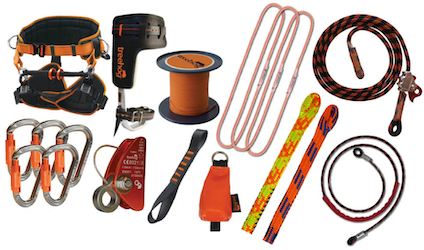
There's general climbing gear that everyone needs and uses for everything from personal safety to tower raising.
The first thing I'll talk about is general gear, that everyone needs.
First off, everything I talk about here is "climber-grade". Nothing you will find in a hardware store is good
enough to bet your life on. Hardware store gear is for "load lifting" only. Get your climbing gear from a
climbing or sports store in your area, or online. There are a wide variety of brands, and like with most things,
the big name brands are more expensive, but they're also higher quality. If you're on a tight budget, the only
inexpensive brands I'd recommend are GM Climbing and Mad Rock. Hardware-store grade tackle and rope
can be used for load-lifting when you're starting, but it's still better to use certified gear even when you're
not hanging from it.
ALL climbing gear is marked with its weight rating, in kilo-newtons, abbreviated "kN". For something like a
carabiner, there are three ratings, showing how strong it is lengthwise, side-to-side, and lengthwise with the
gate opened. kN is a measure of force (not weight) but under earth's gravity 1kN is about 225 pounds. Remember
that when gear has to catch something that's falling, it must stop many times more than the static weight, so
you're going to see ratings starting around 6kN, working their way sometimes past 30kN. This rating is also
known as the Minimum Breaking Strength. ("MBS") It may hold more, but as long as it hasn't been damaged,
it should hold at least that much.
Climbing gear does de-rate over time. Harnesses, ropes, and other complex gear come with asset tags to track
the age of the gear, and everything should be inspected prior to use. Damaged gear should be throw away. If
there is any concern about someone fishing it out of the can and trying to use it, cut it up so no one is tempted.
Manufacturers will have a recommended "retirement age" for gear, which can vary depending on use or signs
of wear.
Carabiners are the most versatile tool. They're available in a variety of types, though the first one you need
to look at is the "triple locking" variety. All of them require three distinct actions to open, usually a pull,
a twist, and a swing. All three are spring-loaded, so if you let go it'll swing shut, twist, and snap down,
fully re-locking itself automatically. The swing gate can't be opened by accident, for example by a rope or some
other force pushing on the gate. They're the safest, get one of these for your harness. I'd also suggest
getting at least one more as an extra / spare. Most carabiners are (length) rated around 25kN, though the big
one on my harness is rated 38kN, my highest rated carabiner. Another common carabiner is the "single action"
variety, used on things like QuickDraws, which are two carabiners connected by a short strap. Rappellers use
them to attach to anchor points, where one carabiner connects to the metal anchor and the other you tie your
rope into. These are still very reliable and strong, and used to be bought very reasonably in 5-packs. This
made them a very good value to get 2-3 useful quick-draws and 4-6 carabiners. Prices have gone up quite a
bit but they're still a good source of inexpensive carabiners.
Rope is the next most important tool, but not the long one. Climbers need to tether tools and objects to the
tower and position themselves for working, and for that you need lighter duty rope called "accessory cord".
This rope is still strength-rated, but isn't designed for catching a falling climber. The rating is lower,
and more importantly the rope has almost no stretch to it, aka "static line". Coming to a sudden stop at the
end of a static line isn't much different than hitting a brick wall, so don't suspend yourself exclusively on
accessory cord. It's okay to use for positioning, but always stay connected to the tower. Rope is rated a bit
differently than hardware. Instead of a single rating, a static line will have both a Working Load Limit (WLL)
and an MBS as with the carabiner. Typical WLL is 1/5 the MBS. So a rope with an MBS of 1,200 pounds
probably has a WLL of 240 pounds. Don't place more than the rope's WLL in weight on it. I keep my rope bags
clearly marked with their MBS and WLL. Free-climbers will use a different kind of rope for safety when
climbing cliffs and other courses. This rope is known as "dynamic line", and stretches considerably under
tension. This stretch slows a climber's fall much more gradually, reducing likelihood and extent of injury when
the rope finally brings them to a stop. They may still get a sprain or other injury, but it's better than hitting
the ground at the bottom of the cliff. Tower climbers don't usually use dynamic line because they're not using
anchor points or rappelling down. When lifting and lowering loads, you don't want a stretchy rope, so most of
my ropes (and all accessory cord) is static line. Non-climber grade rope can be used here as long as you're
never using it for personal safety. A roll of paracord-550 will easily get you started.
For tower work, you'll have to have a heavy long rope for lifting and lowering big items like tower sections,
antennas, and rotors. You'll also want a long light rope to use for lifting and lowering tools, supplies, and
lighter items up and down the tower. You're going to need some way to stay attached to the tower while you
work. In the past I've used heavy accessory cord cut to a length that's convenient. Webbing can also be used.
Some webbing is available with multiple loops along its length, which can be very handy for getting the right
distance between your harness's carabiner and the tower. More accessory cord can be used for positioning if
needed. The idea with the positioning ropes is to save climber strength, because keeping your body stiff to
hold yourself in position will tire you out over time. There's not a lot of purpose-built gear for positioning.
beyond a few uncommon "chain webs" and short webbing with built-in clips, so you'll probably end up
needing to put together something that works for you.
Now that you're safely tied to the tower and can raise and lower things, I suggest a fanny pack to put tools
in. A canvas toolbox is also handy to keep tower tools in, and is easy to haul up once you're in position.
last updated 03/03/2026 at 10:46:13 by make_www_index.command version 2026.02.05.A