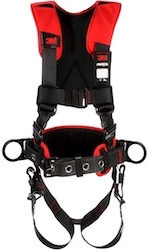
My first harness was just a rappelling waist harness, which isn't ideal for climbing, since it doesn't do much
to keep ahold of you if you happen to flip sideways or upside-down. I suggest getting a full harness, with
shoulder straps, rescue loop on the back, and preferably some positioning straps or rings attached to the hips.
The harness should also have a place for a centrally-mounted carabiner, where you should attach a good triple-
locking carabiner. When I had outgrown my rappelling harness, I got a much better Miller harness, which was
a good all-around design intended both for safety and climbing. A lot of the commonly-available harnesses are
only designed for safety, and so lack the front carabiner and positioning straps. They rely exclusively on
the rescue loop on the back, to attach a fall-arresting cable to some point overhead while working. If they
fall, the cable slows and stops their fall, and leaves them hanging there for someone to come rescue. Some of
the cheaper harnesses aren't designed as well and can cut off circulation if you're left hanging for any length
of time, and also offer no other protective systems.
My Miller has the rescue loop on back, built-in loops on the front for a carabiner, stowable positioning straps
on the sides (a feature that's getting kind of rare to see?), comfortable elastic webbing that's good for long-
term suspension, and a fall-arrest stitching in the webbing that provides additional climber protection with
added deceleration in a fall. (the stitching is single-use only) But all of these nice features come at a much
higher cost.
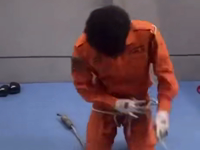
emergency harness.mp4 (569 KB)
last updated 03/03/2026 at 11:59:19 by make_www_index.command version 2026.02.05.A